



WPC decking has become one of the most popular outdoor flooring materials in recent years. However, buyers are often confused when choosing between solid and hollow structures. For importers, distributors, contractors and project buyers, the selection of different WPC decking types greatly affects product weight, structural strength, installation, overall cost and application scenarios.
What Is Hollow‑Core and Solid WPC Decking
These two types of structural‑profile outdoor composite boards are both manufactured from recycled plastic and wood fibre. Their main distinction lies in the inner‑plate structure.
Hollow‑core WPC decking comes with internal cavities. It is lightweight, easy to handle during installation and generally more cost‑effective.
Solid WPC decking consists of one piece of full‑density composite material. It supports heavy‑duty loads, boasts great impact resistance, and resists warping or cracking over years of service, which makes it ideal for high‑traffic zones.
Both options work well for outdoor installations. Your optimal choice relies on project load requirements, budget, installation conditions and practical application scenarios.
Hollow vs. Solid WPC Decking: Key Differences
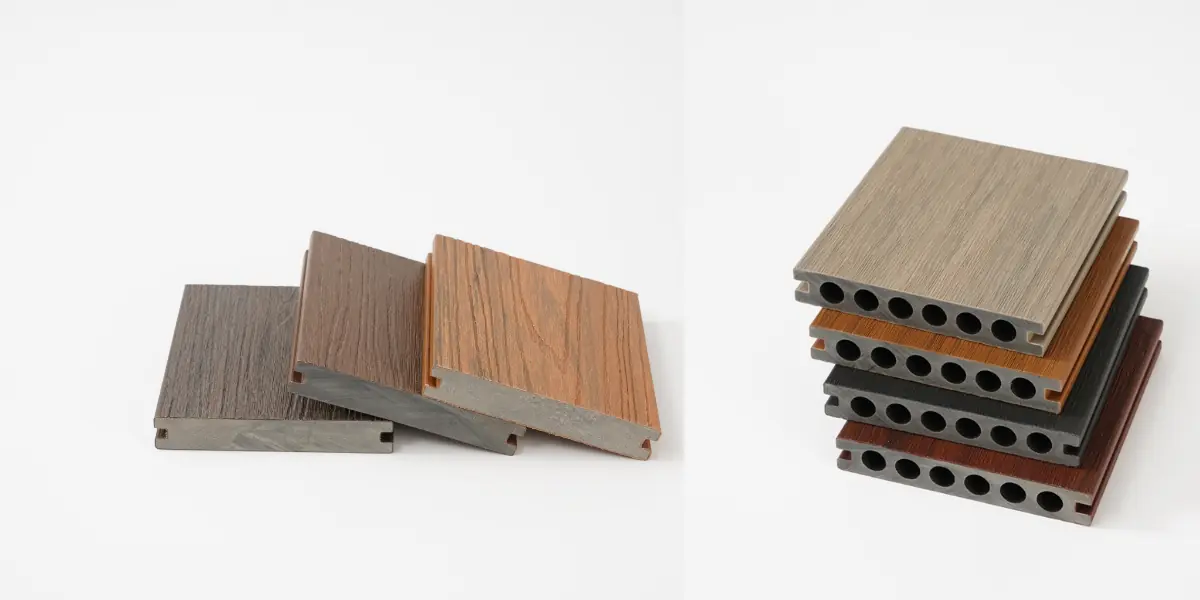
The most important differences between hollow and solid WPC decking are related to internal structure, weight, material consumption, strength, installation and cost.
| Feature | Hollow WPC Decking | Solid WPC Decking |
|---|---|---|
| Internal structure | Hollow chambers | Fully solid |
| Weight | Lower | Higher |
| Material consumption | Lower | Higher |
| Transportation | Easier | Heavier |
| Handling | Easier | More labor-intensive |
| Material cost | Usually lower | Usually higher |
| Impact resistance | Good | Generally higher |
| Load capacity | Depends on profile and joist spacing | Generally higher |
| Installation | Easy to handle | Requires more handling effort |
| Water drainage | Requires proper profile design | Generally less dependent on internal cavities |
| Heavy-duty applications | Limited depending on design | More suitable |
| Residential use | Excellent | Excellent |
| Commercial use | Suitable for many projects | Suitable for demanding projects |
The important point is that profile design and engineering specifications matter just as much as whether the board is hollow or solid.
1. Hollow vs. Solid WPC Decking: Cost
For many importers and distributors, price is a major factor.
Hollow WPC decking generally requires less raw material to manufacture than solid decking.
As a result, hollow profiles can often offer a lower production cost.
This can make them attractive for:
- Large-volume projects
- Residential developments
- Cost-sensitive markets
- Distributors
- Landscaping projects
Solid WPC decking generally consumes more material, so its initial product cost can be higher.
However, buyers should avoid comparing price based only on price per board.
A better comparison is:
Price per square metre + shipping cost + installation cost + expected service life
A lightweight hollow profile may reduce transportation and handling costs, while a solid profile may provide additional durability for demanding applications.
2. Hollow vs. Solid WPC Decking: Weight
One of the most obvious differences is weight.
Because hollow WPC decking contains internal cavities, it uses less material per linear metre or square metre than an equivalent solid profile.
This can make hollow decking easier to:
- Carry
- Cut
- Position
- Load
- Unload
- Transport
- Install
For large projects, the weight difference can become particularly important.
For example, if thousands of decking boards are being shipped, a lighter hollow profile may help reduce the overall shipment weight.
However, buyers should compare the actual weight per square metre, rather than simply asking whether a board is hollow or solid.
Different manufacturers may use different:
- Board dimensions
- Wall thicknesses
- Cavity designs
- Material formulations
- Density levels
Therefore, two hollow WPC decking products can have noticeably different weights.
3. Hollow vs. Solid WPC Decking: Strength
Strength is another major consideration.
Solid WPC decking has more material throughout its cross-section, which generally gives it a stronger and more substantial profile.
This can be beneficial for applications exposed to:
- Heavy foot traffic
- Higher impact
- Frequent furniture movement
- Commercial use
- Higher expected loads
However, hollow WPC decking is not necessarily weak.
A well-designed hollow profile can achieve good structural performance through:
- Proper cavity geometry
- Adequate wall thickness
- Reinforced internal ribs
- Correct joist spacing
- Suitable WPC formulation
This means buyers should not judge decking performance solely by the word “hollow.”
Instead, ask the supplier for the product’s technical specifications and recommended installation span.
4. Hollow vs. Solid WPC Decking: Installation
Installation is another area where hollow WPC decking can have an advantage.
Because hollow boards are lighter, workers can generally handle longer boards more easily.
This can make installation more convenient on:
- Residential decks
- Balconies
- Garden terraces
- Rooftops
- Landscaping projects
Solid boards are heavier, which can increase handling effort, especially when workers need to move large quantities of material.
However, installation quality depends on more than board weight.
A professional WPC decking system should also include:
- Joists
- Clips
- Screws
- Starting clips
- Edge trims
- Proper expansion gaps
Correct joist spacing is particularly important because inadequate support can cause deflection regardless of whether the decking is hollow or solid.
5. Hollow vs. Solid WPC Decking: Durability
Both hollow and solid WPC decking can provide good outdoor durability when properly manufactured.
WPC decking is designed to offer advantages such as:
- Moisture resistance
- Resistance to rot
- Resistance to insect damage
- Low maintenance
- Good weather resistance
- Reduced risk of cracking compared with some traditional wood decking
However, durability depends heavily on product quality.
Important factors include:
WPC formulation
The ratio of wood fibre, polymer and additives affects the performance of the final product.
Surface treatment
Different surface finishes can affect appearance, stain resistance and weathering performance.
UV stabilizers
Outdoor WPC decking needs suitable UV protection to help maintain colour stability.
Manufacturing quality
Poor extrusion control can result in inconsistent dimensions, weak areas or uneven wall thickness.
Therefore, “solid” does not automatically mean durable, and “hollow” does not automatically mean low quality.
6. Hollow vs. Solid WPC Decking: Heat and Outdoor Comfort
Both hollow and solid WPC decking can become hot under direct sunlight.
The surface temperature is affected more strongly by factors such as:
- Board colour
- Solar radiation
- Ambient temperature
- Surface finish
- Ventilation
- Installation location
Dark-coloured decking generally absorbs more solar energy than lighter-coloured decking.
The internal structure can influence heat transfer to some degree, but buyers should not assume that hollow WPC decking will always feel significantly cooler than solid decking.
For poolside, rooftop and other exposed applications, colour selection and site conditions are important considerations.
7. Hollow vs. Solid WPC Decking: Water Drainage
A common misconception is that hollow decking automatically has better drainage.
In reality, drainage depends primarily on the decking profile and installation system.
Outdoor WPC decking should be installed with appropriate gaps between boards so that rainwater can drain away.
The substructure should also provide adequate ventilation and drainage.
For hollow WPC decking, it is particularly important to consider how the internal cavities are exposed at the board ends.
In some applications, end caps or other profile accessories may be used to improve appearance and reduce the entry of dirt or debris.
Hollow vs. Solid WPC Decking: Which One Should Importers Buy?
For importers, the decision should go beyond the hollow-versus-solid question.
Before placing an order, compare the following specifications:
| Specification | What to Check |
|---|---|
| Profile | Hollow or solid |
| Dimensions | Width × thickness × length |
| Weight | kg/m or kg/m² |
| Density | WPC density |
| Wall thickness | Important for hollow profiles |
| Joist spacing | Recommended installation span |
| Surface | Wood grain, brushed, co-extruded, etc. |
| Colour | Available colour options |
| UV resistance | Outdoor weathering performance |
| Water absorption | Important for outdoor applications |
| Expansion | Thermal expansion characteristics |
| Packaging | Carton, pallet or customized packaging |
| MOQ | Minimum order quantity |
| Warranty | Supplier warranty terms |
This information allows buyers to make a more accurate comparison between suppliers.
Final Verdict: Hollow or Solid WPC Decking?
The real‑world gap between hollow and solid WPC decking lies in trade‑offs of weight, cost, structure and usage demands instead of simple quality gaps.
Pick lightweight, budget‑friendly hollow WPC decking for easy installation. Go for sturdy solid‑type one for high‑impact‑resistant commercial projects.
As bulk purchasers, check full specs including density, load capacity and surface finish before orders.
Linyi Chili New Materials supplies durable, low‑maintenance WPC decking for diverse outdoor scenarios.